The Premise
The Bank of Canada has held the overnight rate at 2.25% since October 2025, and the consensus forecast keeps it there through the end of 2026. That much is widely reported. What is less widely understood is what the rate stability does to the underwriting math on CMHC's MLI Select program for a typical purpose-built rental or rental conversion in Ontario's secondary markets.
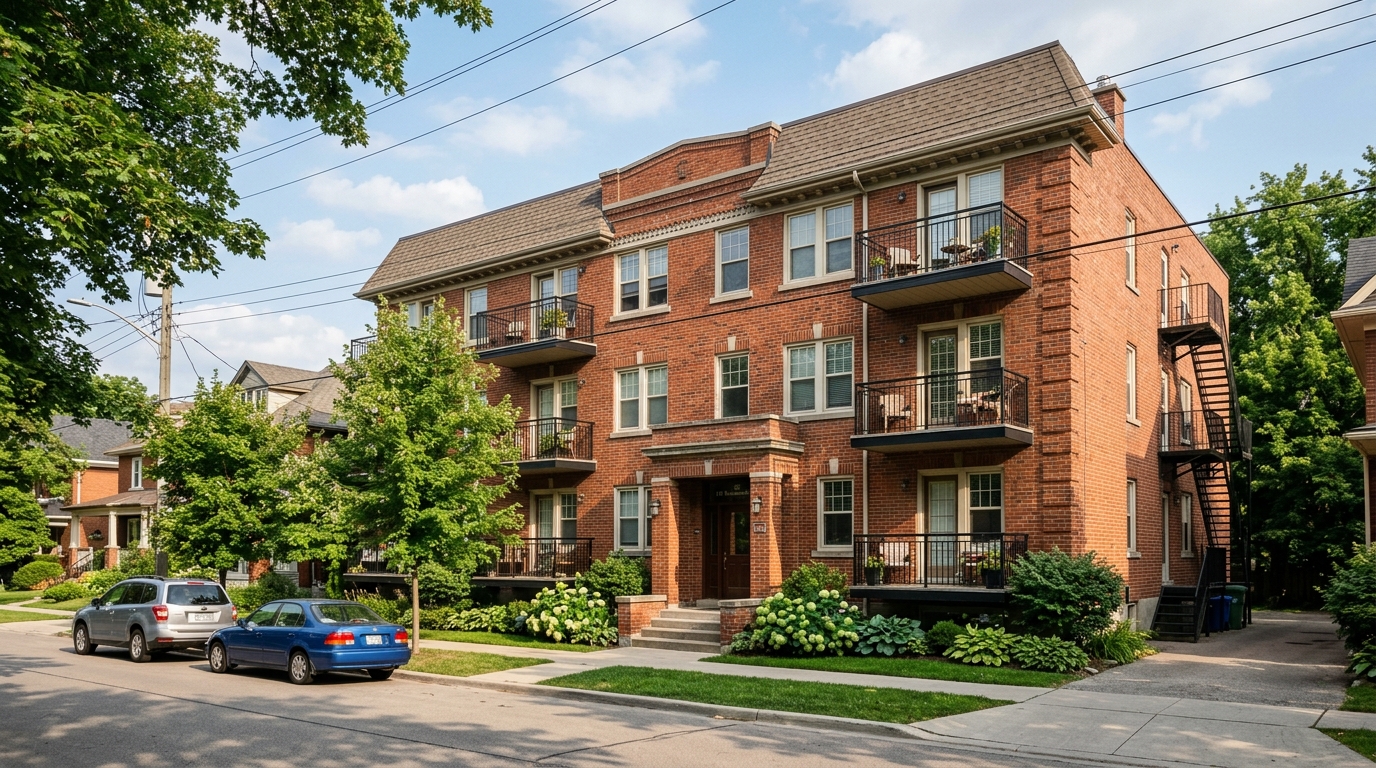
This piece runs the numbers. The example is a 24-unit apartment building in London, Ontario, with average market rent of $1,650 per unit. It is the kind of deal that crosses our desk at Yield the North roughly twice a quarter. The takeaway is that the financing math gets meaningfully better without a single rate cut, simply because of how MLI Select works at a stable anchor rate.
The Building
Twenty-four units. Average market rent $1,650 per door. Stabilized vacancy assumption of 3% per CMHC's latest London Rental Market Survey. Stabilized operating expense ratio of 32% inclusive of property tax, insurance, utilities, repairs and maintenance, and management. Capital reserve of $300 per door per year.
That produces $475,200 in gross potential rent, $460,944 in effective gross income, $313,442 in net operating income after operating expenses and reserves. At a 5.25% market cap rate, the as-stabilized value is approximately $5.97 million.
The Conventional Debt Stack
Under conventional Schedule A bank financing in May 2026, the deal pencils as follows. Loan to value of 75% at a five-year fixed rate of approximately 5.10%, with a 25-year amortization. The maximum loan is $4.48 million. Annual debt service is $317,856. The debt service coverage ratio is 0.99.
That DSCR is below the 1.20 minimum that almost every conventional lender requires for stabilized multifamily. So in practice the deal does not get conventional financing at this leverage. The buyer either contributes more equity, which compresses the levered return, or restructures the deal.
This is the math that has stalled conventional multifamily acquisitions in Ontario secondary markets for the past 18 months.
The MLI Select Stack
Now the same building under CMHC MLI Select. The program offers up to 95% LTV and amortizations up to 50 years for projects that meet a combination of affordability, energy efficiency, and accessibility criteria. The points-based system rewards higher scoring with better terms.
For a typical conversion or new build that hits the mid-band of MLI Select scoring, the realistic stack is 85% LTV at a 50-year amortization, with insurance premium of approximately 5% and a five-year fixed rate of approximately 4.20%. The five-year rate is lower than conventional because the loan is CMHC-insured, which removes default risk from the lender's pricing.
At 85% LTV, the maximum loan is $5.08 million. Annual debt service at 4.20% and 50-year amortization is $264,624. The debt service coverage ratio is 1.18.
The DSCR is still tight by traditional standards, but MLI Select underwrites to 1.10 minimum, not 1.20. The deal gets the loan.
The Equity Math
Conventional path. $4.48 million debt plus $1.49 million equity equals $5.97 million purchase. At a $313,442 NOI and $317,856 in debt service, the cash on cash return in year one is negative. The deal does not get funded.
MLI Select path. $5.08 million debt plus $0.89 million equity equals $5.97 million purchase. At a $313,442 NOI and $264,624 in debt service, the levered free cash flow is $48,818 in year one. The cash on cash return is 5.5%.
The MLI Select route delivers a 5.5% cash on cash return at year one, with a 50-year amortization that gives the operator decades of stable financing, on a deal that conventional financing cannot make work.
Where the Math Got Better Without a Cut
Three changes between mid-2024 and May 2026 are driving the improvement.
First, the BoC anchor at 2.25% has compressed the five-year CMHC rate from roughly 5.40% in mid-2024 to approximately 4.20% today. That is 120 basis points of rate compression on the financing side without a single overnight rate cut since October.
Second, the MLI Select program structure has stabilized. The 50-year amortization and the 85% LTV at mid-band scoring have been consistent for the past 12 months. Underwriters have moved from "is this program still around" to "how do we score this deal." That confidence flows into faster approvals and tighter pricing.
Third, secondary market rents in London, Chatham, and Hamilton have continued to rise at 4% to 6% per year, even as headline GTA rent growth has slowed. The combination of rising NOI and falling debt cost is doing the work that a rate cut would have done.
What This Means for the Operator
Three operational takeaways.
First, every refinance that comes up in 2026 should be evaluated for MLI Select eligibility, even if the building was originally financed conventionally. The combination of 50-year amortization and lower coupon can release meaningful equity for the operator while improving DSCR. We have run six refinances through this analysis at Yield the North in the past nine months, and four of them moved to MLI Select.
Second, the energy efficiency and accessibility scoring tests matter. A building that scores in the 50s under MLI Select gets meaningfully better terms than one that scores in the 30s. The cost of the upgrades that move scoring up is small relative to the financing improvement. For a 24-unit building, a $40,000 efficiency upgrade can release $200,000 of additional loan proceeds.
Third, the math does not work everywhere. In markets where rents are flat or falling, the increased leverage simply transfers more risk to the operator. The 5.5% cash on cash return in the example above depends on stable to rising rents. In a market where rent growth turns negative, the same leverage becomes the problem.
The Bottom Line
The BoC's stability at 2.25% is not a non-event. It has reset the underwriting math for purpose-built rental and rental conversions in Ontario through MLI Select. Operators who understand the program scoring, run the worked example honestly, and refinance into the right structure are extracting returns that conventional debt cannot deliver in the same environment.
The rate cut that did not happen turned out to be less important than the policy stability that did.